Built to Burn You Slowly: The Flame Retardant Problem Hiding Inside Your Walls
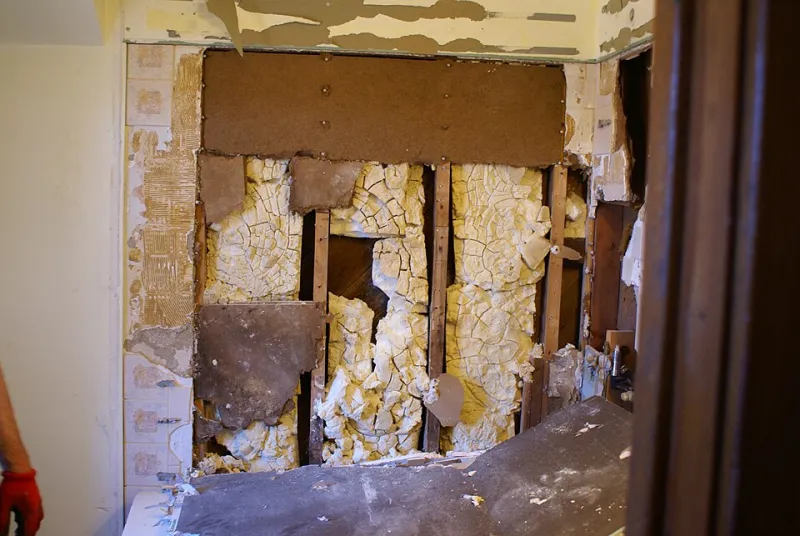
Photo: TomKonrad, CC BY-SA 3.0, via Wikimedia Commons
You painted the walls. You chose the flooring. You obsessed over cabinet hardware and the exact shade of white for the trim. But there's a layer of your home you probably never thought to question — the stuff inside the walls, tucked behind the drywall, packed between the studs — and it may be slowly releasing chemicals into the air your family breathes around the clock.
Flame retardants have been added to building materials for decades, pushed by a combination of fire safety regulations and aggressive lobbying from the chemical industry. The idea sounds reasonable enough on the surface: treat materials so they don't ignite as easily. But the chemicals used to achieve that goal don't just sit there quietly. They migrate. They off-gas. They settle into your household dust and find their way into your body — and your kids' bodies — through inhalation, ingestion, and skin contact.
This isn't a fringe concern. It's a well-documented public health issue that the construction industry has been slow to reckon with.
What Are Flame Retardants, Exactly?
Flame retardants are a broad class of chemicals added to materials to slow or suppress combustion. In building products, you'll find them in spray polyurethane foam (SPF) insulation, rigid foam board, fiberglass batt insulation facings, drywall compounds, electrical wiring insulation, and certain adhesives and sealants.
The most notorious among them are PFAS compounds — per- and polyfluoroalkyl substances — which include PFOA (perfluorooctanoic acid) and PFOS. These are the so-called "forever chemicals," named that because they don't break down in the environment or in the human body. They accumulate over time, building up in tissue, blood, and organs.
But PFAS aren't the only players. Organophosphate flame retardants (OPFRs) like TCEP and TDCPP have largely replaced the older, banned polybrominated diphenyl ethers (PBDEs) — but emerging research suggests they carry their own set of risks, including endocrine disruption and potential carcinogenicity. Trading one problem chemical for another isn't exactly progress.
How These Chemicals Get From Your Walls Into Your Blood
Here's the part that should make you put down your coffee for a second.
Flame retardants don't stay put. Foam insulation, in particular, is notorious for off-gassing — releasing volatile compounds into the air over time, especially in the months following installation. Spray polyurethane foam that hasn't fully cured is especially problematic, and improper installation can dramatically increase the amount of chemical vapor released into your living space.
Beyond off-gassing, these chemicals bind to dust particles. Household dust — that stuff accumulating on your baseboards and bookshelves — is one of the primary exposure routes for flame retardants in residential settings. Studies have consistently found flame retardant compounds in indoor dust samples from American homes, often at concentrations significantly higher than outdoor air.
Children are disproportionately affected. They spend more time on the floor, they put their hands in their mouths, and their developing bodies are far more vulnerable to endocrine-disrupting compounds. Research from the Silent Spring Institute and other environmental health organizations has linked early-life PFAS exposure to immune dysfunction, thyroid disruption, and developmental delays.
For adults, the picture isn't much prettier. PFOA specifically has been associated with kidney and testicular cancer, elevated cholesterol, thyroid disease, and reproductive issues. The EPA has moved in recent years to tighten regulations around PFAS in drinking water, but standards around building materials remain frustratingly loose.
Which Building Materials Are the Biggest Offenders?
Not all construction materials carry equal risk. Here's where the heaviest concentrations tend to live:
Spray Polyurethane Foam (SPF) Insulation — Widely used in attics, crawl spaces, and wall cavities, SPF can contain flame retardants and isocyanates that off-gas during and after application. Some formulations have been reformulated in recent years, but verification is tricky without asking very specific questions of your contractor.
Rigid Foam Board Insulation — Extruded polystyrene (XPS) and expanded polystyrene (EPS) boards frequently contain HBCD (hexabromocyclododecane) or newer OPFR replacements. XPS, in particular, has been a persistent offender.
Fiberglass Batt Insulation — The fiberglass itself is generally inert, but the kraft paper or foil facing used on some batts may contain flame retardant treatments.
Electrical Wiring and Conduit — The plastic jacketing on wiring is often treated with flame retardants, and over decades, this material can degrade and contribute to dust contamination.
Drywall Joint Compounds and Coatings — Less studied than insulation, but some formulations contain chemical additives worth scrutinizing.
What You Can Actually Do About It
If you're building new or planning a renovation, you have more leverage than you might think. The key is asking the right questions before work begins — not after the walls are closed up.
Demand transparency from your contractor. Ask for the Safety Data Sheets (SDS) on every product being installed inside your walls. A good contractor won't flinch at this request. If they do, that's information too.
Look for flame retardant-free insulation options. Mineral wool (rock wool or slag wool) insulation is naturally fire-resistant without added chemical treatments. It's worth the extra conversation with your builder. Some cellulose insulation products use borate-based treatments, which are far less concerning than PFAS or OPFR compounds.
Choose open-cell SPF carefully — or avoid it. If spray foam is on the table, ask specifically whether the product is third-party verified as flame retardant-free. Some manufacturers now offer FR-free formulations. Make sure the foam is fully cured before occupying the space — typically 24 to 72 hours minimum, with adequate ventilation.
Ventilate aggressively during and after renovation. Fresh air exchange is your best short-term defense against off-gassing. Open windows, run exhaust fans, and if you've had significant work done, consider an air quality test before resuming normal occupancy.
Upgrade your air filtration. A quality HEPA air purifier in main living areas — especially bedrooms — can meaningfully reduce airborne particle load, including dust-bound flame retardant compounds. It won't eliminate the source, but it reduces your daily exposure.
Dust smarter. Wet mopping hard floors instead of dry sweeping, and using a vacuum with a HEPA filter rather than a standard bag or bagless model, significantly reduces the amount of contaminated dust you're recirculating into the air.
The Bigger Picture
There's something deeply uncomfortable about the idea that the materials protecting your home from fire might be quietly compromising your health in another way. But that tension is exactly the kind of trade-off the chemical industry has exploited for decades — framing toxic compounds as the price of safety, while burying the evidence of harm.
The good news is that alternatives exist. The market for cleaner building materials is growing, driven by consumer demand and a slowly evolving regulatory landscape. Organizations like the Healthy Building Network publish databases of safer building product options, and green building certifications like LEED and the Living Building Challenge increasingly require disclosure and avoidance of high-concern chemicals.
Your home should be a refuge. That starts with knowing what it's actually made of.